
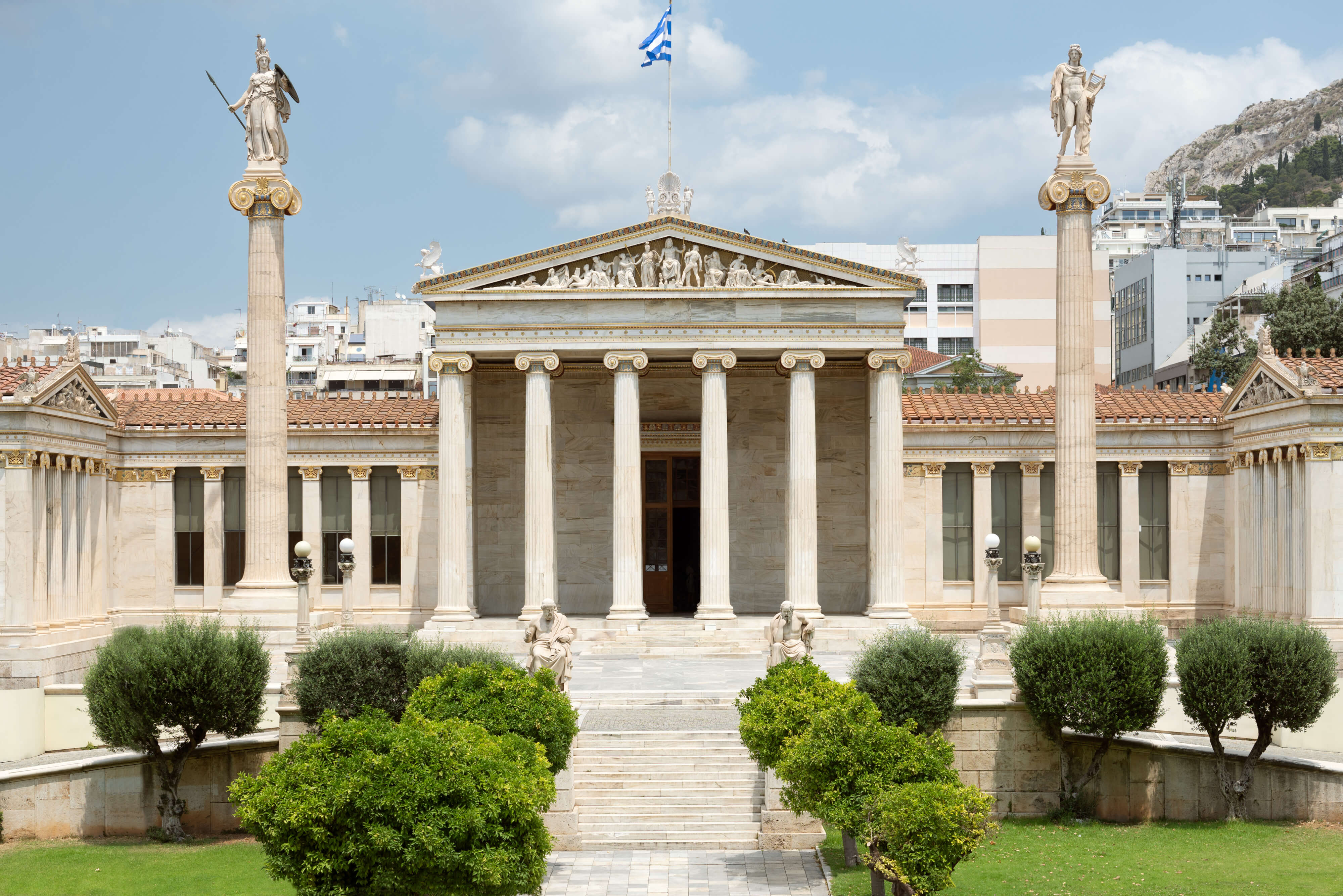
The neoclassical building of the Academy of Athens was designed in 1859 by the renowned Danish architect Theophil Hansen and was fully financed by the philanthropist Baron Simon Sinas. The Academy of Athens, founded by constitutional decree on March 18, 1926, is Greece’s National Academy for the Sciences, Humanities and Fine Arts, in honor of Plato’s original Academy. Panagiotis Aristophron, a renowned architect and philanthropist, deeply inspired by Plato’s vision, purchased an estate in the Akademia area with the aim of uncovering and restoring the ancient Academy. He led and sponsored the first systematic excavation in the area, which was conducted between 1929 and 1939, under the supervision of archaeologist and academician Konstantinos Kourouniotis. Excavations revealed a large gymnasium complex, including a rectangular court and portions of a square peristyle.
Unfortunately, due to the onset of World War II, Aristophron left Greece in 1939 for Alexandria, where he passed away in 1944, before his work could be completed. Excavations resumed between 1956 and 1963, led by archaeologist Phoebus Stavropoulos with the financial support of the Academy of Athens. These excavations uncovered the so-called “House of Hekademos” and the Sacred House. Further archaeological work continued between 1990 and 2002 under the Greek Ministry of Culture, sponsored by the Academy of Athens.
In his 1937 will, Aristophron bequeathed approximately 50,000 square meters of land in and around the archaeological park to the Academy of Athens. As stated in his will, his expressed intent was to establish an International Community (Koinon) of Academies - a collaborative venue for global academies, universities, and research institutions, reviving the spirit of Plato’s Academy on its original grounds.